

Visiting the 9/11 Memorial with Children: Age Guide
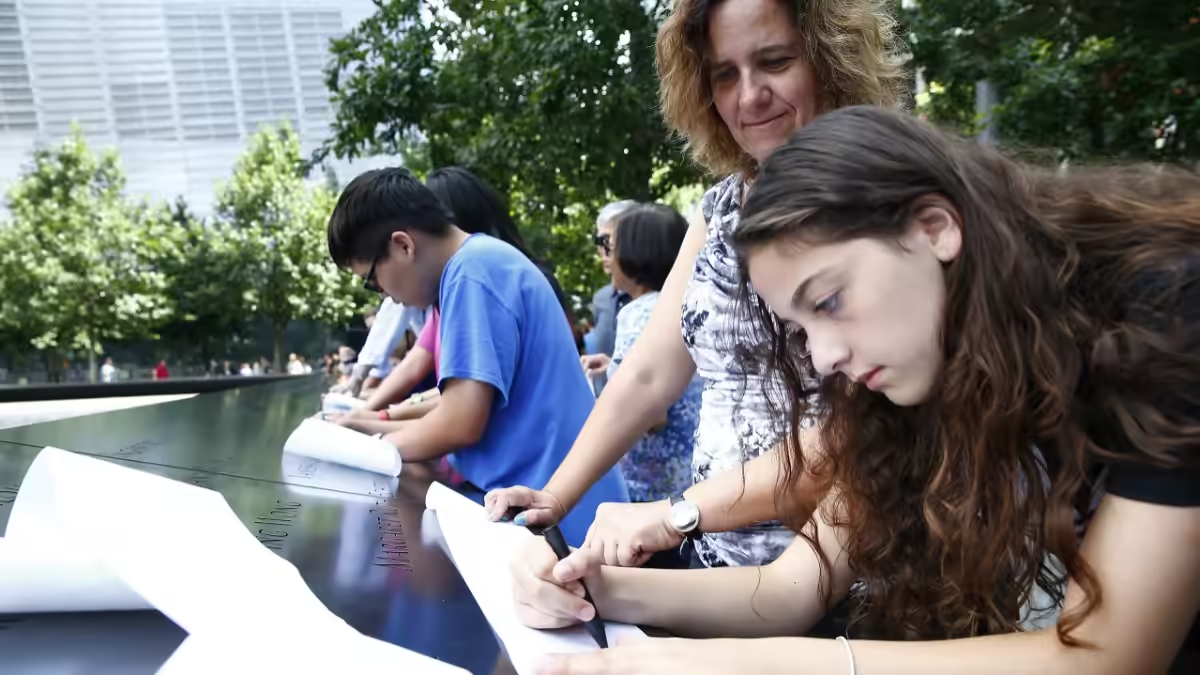
The outdoor 9/11 Memorial plaza is appropriate for visitors of any age and can be visited free of charge. The underground Museum is different: it holds photographs, recorded audio, and artifacts documenting the attacks that many children find distressing, and the Museum itself notes that some content may be difficult for younger visitors. Families can choose to see the Memorial only, prepare children in advance for what the Museum contains, and plan to take breaks or leave early if needed.
Families visit the World Trade Center site for many reasons, and there is no single right way to bring a child here. This guide sets out what to expect at each part of the site, some age-by-age considerations, and practical ways to prepare children beforehand, so you can decide what fits your family.
None of this is a rule to follow exactly. You know your child, and the guidance below is meant to support that judgment, not replace it.
The Memorial and the Museum Are Different Experiences
The outdoor Memorial plaza — the twin reflecting pools, the inscribed names, the Survivor Tree, and the Memorial Glade — is a quiet, contemplative space that is free and open to all ages. The Museum, below ground, presents the history of the attacks directly, including imagery, audio, and personal artifacts that can be emotionally intense. Families do not have to choose the Museum in order to visit the site.
It helps to hold these as two separate decisions. The plaza is a place of mourning and remembrance, open to the public daily with no ticket required, and most families find it a suitable place to bring children of any age. The Museum, by contrast, documents the events of September 11, 2001 in close detail, and its exhibits are built for an adult audience first. Our guide to the Memorial versus the Museum sets out what each part of the site includes.
The Museum states on its own materials that some of its content may not be suitable for younger children, and it offers family and education resources to help visitors decide what’s right for their group. Reading that guidance on the official site before you book is a reasonable first step for any family with young children.
Age-by-Age Guidance
There is no fixed age cutoff, and children mature at different rates, so treat the following as a starting point rather than a rule.
Young children (roughly under 7): The outdoor Memorial is generally a calm, manageable visit for this age group, though the scale of the pools and the crowds can be a lot to take in. The Museum’s exhibits — which include recordings of phone calls made during the attacks, images of the towers burning and falling, and recovered personal belongings — are widely considered too intense for most children this young. Many families in this stage choose the Memorial plaza only.
Older children (roughly 7–12): Some families in this range visit the Museum’s historical exhibition, while others wait. If you do bring a child this age, consider previewing what the galleries contain, going at a quieter time, and being ready to skip a section or step outside together if something is too much. The Museum’s in-gallery information can help you both decide what to look at closely and what to pass by.
Teenagers (13–17): Most teenagers are old enough to engage meaningfully with the Museum’s historical exhibition, and for many families this is an appropriate age to discuss what happened in more depth. Even so, some of the material is difficult for adults, so check in with your teenager before, during, and after the visit rather than assuming the content won’t affect them.
Whatever a child’s age, the decision often has as much to do with an individual child’s sensitivity and prior knowledge of the attacks as it does with their age in years.
How to Prepare and Talk to Children Beforehand
Before visiting, give children an age-appropriate explanation of what happened on September 11, 2001 and what they will see, rather than letting the site itself be the first introduction. Let them know it’s fine to skip a room, ask questions, or ask to leave. A short conversation beforehand tends to make the visit easier for everyone.
A brief conversation before you arrive can make a real difference. Explain, in terms suited to your child’s age, that a terrorist attack happened in New York on September 11, 2001, that many people were killed, and that the Memorial and Museum exist to remember them and explain what happened. You don’t need to cover every detail; the goal is simply that the site isn’t the child’s first exposure to the subject.
It also helps to tell children what to expect physically: that the plaza has two large pools of water with the names of those killed carved into bronze around the edges, that the Museum is underground and can feel dim and quiet in places, and that some rooms contain photographs and recordings about the attacks. Letting a child know in advance that it’s fine to walk past something, ask a question, or ask to step outside gives them a sense of control over the experience.
If your child has already learned about September 11 at school or has asked questions about it, that prior context can make the Museum more meaningful. If the subject is entirely new to them, consider whether the outdoor Memorial alone might be the better starting point, with the Museum saved for a later visit.
What to Expect Inside the Museum
The Museum’s exhibits are organized to walk visitors through the day of the attacks, the historical background, and the aftermath, and they rely on primary material: recorded 911 calls and voicemails, video footage, twisted structural steel, and personal items recovered from the site. Foundation Hall, with the exposed slurry wall and the Last Column, is physically striking but not graphic in the way some of the historical exhibition’s imagery is. Families sensitive to specific content — audio of phone calls, images of people, or recovered personal effects — may want to move through certain galleries more quickly or skip them.
The Museum also posts content notices near some of its most intense exhibits, and staff are generally available if you have questions about what a particular gallery contains. It’s reasonable to ask a staff member at the entrance which sections to be mindful of if you’re visiting with a child.
Visiting the Memorial Only
Families are welcome to visit only the outdoor Memorial plaza, at no cost and with no ticket required, and to skip the Museum entirely. This is a common choice for families with young children or anyone who prefers not to take on the Museum’s more intense material. The Museum will still be there for a future visit if a child is older or more prepared later on.
Choosing the Memorial only is not a lesser visit. The plaza itself is where the reflecting pools sit in the footprints of the Twin Towers, where the names of those killed are inscribed, and where the Survivor Tree and Memorial Glade stand — all of it open daily and free to enter. A family can walk the plaza, read some of the names, and spend as much or as little time as feels right, without ever going underground. If you’re undecided, our guide on whether the Memorial and Museum are worth visiting may help you weigh the choice for your family.
There’s also no obligation to decide once and for all. Some families visit the plaza with younger children on one trip and return for the Museum years later, when the children are older.
Taking Breaks and Leaving Early
Both parts of the site allow for breaks. Outdoors, there are benches around the plaza where you can sit away from the pools if a child needs a quieter moment. Inside the Museum, exiting a gallery early or stepping into a quieter corridor is entirely acceptable, and tickets are timed for entry only, not for a fixed exit time, so there’s no pressure to finish everything once you’re inside.
If you sense a child is overwhelmed, it’s reasonable to leave the Museum altogether and continue the visit on the plaza instead. Building in slack — arriving without a tightly packed schedule, and not planning much else immediately afterward — tends to make it easier to end the visit whenever your family is ready. Our guide to how long to spend at the Memorial and Museum can help you plan a visit with room to pause.
It’s also worth reviewing the site’s general rules and etiquette beforehand, since both the plaza and the Museum are places of mourning, and quiet, respectful behavior is expected throughout.
Frequently Asked Questions
Is the 9/11 Memorial appropriate for young children?
Yes. The outdoor Memorial plaza is a quiet, open space with no ticket required, and most families find it suitable for children of any age. It’s the Museum, not the plaza, where families typically need to think more carefully about a child’s age and sensitivity.
Is the 9/11 Museum too graphic for kids?
The Museum documents the attacks directly, including photographs, video, recorded audio, and recovered personal items, and it notes that some of this material may not be suitable for younger children. Many families choose to wait until children are older, while others visit selectively, skipping the most intense galleries. There is no single answer that fits every child.
What age is recommended for the 9/11 Museum?
There is no official minimum age, and readiness depends on the individual child rather than a fixed number. Teenagers generally engage with the historical exhibition more easily than younger children, but a family’s own judgment about their child’s sensitivity matters more than age alone.
Can we just visit the Memorial and skip the Museum?
Yes. The outdoor Memorial is free, requires no ticket, and can be visited on its own. This is a common choice for families with young children, and the Museum will still be there for a later visit if you decide to return.
How do I explain September 11 to my child before visiting?
A short, age-appropriate explanation beforehand — that a terrorist attack happened in New York on September 11, 2001, that many people were killed, and that the site honors and remembers them — helps children arrive with some context rather than encountering the subject for the first time at the site itself.
Can we leave the Museum early if my child is upset?
Yes. Museum tickets are timed for entry, not for how long you stay, so you can leave any gallery, or the Museum entirely, whenever you need to. Returning to the outdoor plaza is a natural way to end a visit that feels like too much indoors.
Are there quiet places to take a break with kids?
The outdoor plaza has benches away from the reflecting pools where families can sit quietly. Inside the Museum, stepping into a quieter corridor or heading back toward the entrance is also an option if a child needs a pause.
Does the Museum offer any guidance for families?
Yes. The Museum provides family and education resources and posts notices near some of its more intense exhibits. Checking the official site’s family guidance before you visit, or asking staff at the entrance, is a reasonable way to plan ahead.
